The Information Technology Infrastructure Library
These days, it goes without saying that the worlds of business and technology are inextricably linked. In order to stay competitive, a company needs to be able to evolve both its corporate objectives and IT capabilities, no matter how painful or awkward this process may be.
Naturally, this kind of change cannot start with a blank canvas. The development of IT services should be driven by an awareness of current processes and management practices within an organization. Without this, an IT Service Management (ITSM) process will inevitably waste time, money and effort, giving competitors a chance to lure customers away with more efficient offerings.
What Exactly is ITIL?
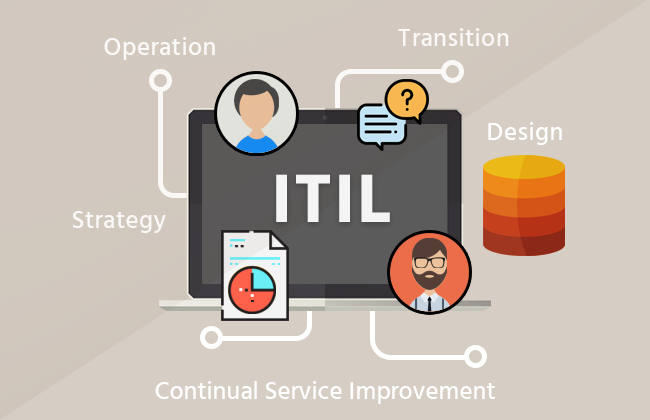
The IT Infrastructure Library (ITIL) is a library of volumes describing a framework of best practices for delivering IT services. ITIL has gone through several revisions in its history and currently comprises five books, each covering various processes and stages of the IT service lifecycle. ITIL’s systematic approach to IT service management can help businesses manage risk, strengthen customer relations, establish cost-effective practices, and build a stable IT environment that allows for growth, scale and change.
The main strength of ITIL likes in its versatility. The practices are scalable and flexible, allowing organizations to take on as much or as little of them as they like. ITIL can even be adapted to work in conjunction with other practices, including COBIT, SixSigma and TOGAF.
So, what is ITIL? It is a series of processes for refining and improving an IT service lifecycle. It helps to boost the capabilities of organizations, processes and people, ensuring that when changes to technology or business practices leave them vulnerable, they can adapt quickly and stay on top of the competition.
How can an ITIL Certification Help my Business?
Think about the digital services that you use on a daily basis. These were not developed in a vacuum; rather, they were built using an ongoing project management process that took into account not only the objectives of the service, but also the potential issues in developing, delivering and maintaining it. In short, there would have been a huge number of factors to consider.
Good IT Service Management is about knowing how to integrate these factors into your development process, and this is where ITIL comes in. It covers the entire development life-cycle, from identifying requirements from a business and IT perspective, to designing and creating the solution, to delivering and maintaining the service in a state of continual review and improvement.
Taking this strategy on board offers a number of advantages for businesses. Perhaps most notably, it can cut back on the amount of time and money that gets wasted throughout the service development life-cycle, while also raising the quality of the end-product. This, in turn, can provide a huge boost to customer satisfaction once a service or product is implemented, as well as the morale of staff working on it.
By investing in a training course and implementing ITIL you can expect to:
- Better understand your customers so that you can deliver services which suit their needs.
- This will help you to build long-term relationships and improve your reputation.
- Learn how to establish a guide on how to predict and react to issues with your service, incorporating multiple factors such as user experience rather than simply focusing on IT development.
- Increase productivity and improve resource management by establishing cost-effective guidelines.
- Manage risks without disrupting or unintentionally sabotaging your service.
- Create a stable service development environment which supports ongoing change.
- Ensure greater alignment between IT and other arms of your business. This can be vital for enterprise architecture development.
- Improve your risk management process by predicting and reducing service disruptions and failures.Create networking opportunities and ease collaboration by incorporating ITIL’s terms and methodologies into your business.
- Quickly adapt to changes in technology, compliance and so on in order to continue growing and maintain your competitive advantage.
- Raise the profile of your business with a globally recognized certification.
You do not need to gain a full Master’s certification, though this is certainly a highly-regarded achievement. The certifications are gained gradually via Foundation, Practitioner and Intermediate modules which will qualify students to takes exams and move onto higher levels.
How TransGemini Can help you earn ITIL Certification?
Being an Authorized Training Provider of ITIL Certifications through VMedu, we can help you right from where to get started from. Not only the courses are fully accredited by PeopleCert, but can also offer months of course access and FREE exam vouchers, ensuring that you will have the tools to become certified as soon as you are ready.
TransGemini offers courses that cover the entire ITIL spectrum. This will allow you to gain all the points necessary to progress to ITIL Intermediate, Expert and Master levels.
 The TransGemini Journal